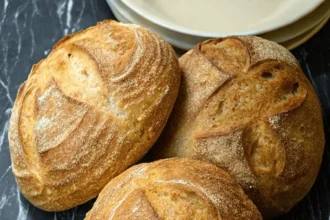


Making sourdough croissants at home is a true baking project, but the reward is worth every fold, chill, and careful roll. These croissants bake up shiny, deeply golden, buttery, and beautifully flaky, with that gentle sourdough depth that makes each bite feel extra special. This is the kind of recipe you make when you want a weekend baking win, especially if you love laminated dough and the slow, satisfying rhythm of sourdough baking. Don’t rush the proofing, keep the butter cool but pliable, and you’ll be amazed at what comes out of your oven. Homemade croissants can feel intimidating, but with clear timing and patient steps, you’ll be a pro in no time!
What Makes These Sourdough Croissants Special
These croissants are all about layers: crisp edges, tender centers, and rich European-style butter folded through the dough. The sourdough levain gives them flavor and structure without making the process feel overly complicated. They’re a perfect project bake for anyone who loves detailed recipes with a big payoff.
Naturally Leavened Butter Croissants
These homemade croissants are flaky, buttery, and deeply satisfying. The process takes time, but each step is simple when you follow the dough, butter, and proofing cues carefully.
Ingredients
Levain
- 60 grams Sourdough Starter
- 60 grams Bread Flour
- 60 grams of water
Croissant Dough (Détrempe)
- 540 grams Bread Flour
- 50 grams Granulated Sugar
- 12 grams Sea Salt
- Levain, see above
- 150 grams Whole Milk, room temperature
- 150 grams Water, room temperature
- 43 grams Unsalted Butter, 3 TBS, cubed, room temperature
Butter Block (Beurrage)
- 340 grams High-fat European-style Unsalted Butter, 3 sticks; Kerrygold and Plugra are popular brands.
Egg Wash
- 1 Egg Yolk
- 2 tsp Whole Milk
Instructions
- Mix the sourdough starter, bread flour, and water in an empty jar. Cover and set in a warm location for about five hours until doubled in size, ripe, and bubbly.
- Once the levain is ripe, make the croissant dough. Add the bread flour, granulated sugar, sea salt, all of the levain, whole milk, and water to the bowl of a stand mixer fitted with the dough attachment.
- Start mixing on low and gradually increase the speed to medium to bring the dough together into a shaggy mass. Cover with a towel and rest the dough for 10 minutes to relax the gluten.
- Continue mixing on medium for about 5 minutes until the dough starts to clear the sides of the bowl. With the mixer running, add the small cubes of butter one at a time until each one is fully incorporated. Continue mixing for 5-7 minutes until the dough is tacky, not sticky.
- Transfer the dough to a bowl, cover, and place in a warm location to proof for about 5 hours or until the dough doubles in size.
- While the dough is proofing, make the butter block. Place the 3 sticks of butter side-by-side on a large piece of parchment paper. Loosely wrap the butter in the parchment paper on all sides like a present and flip it over. Size the parchment into an 8″ (20cm) square, larger than the sticks of butter.
- Smash the butter with a rolling pin. Then, flatten it into the corners of the parchment paper. If any parchment tears, replace it to prevent leaking.
- Roll the butter out evenly into as perfect an 8″ square as possible. Transfer the butter block to the refrigerator.
- Once the dough has doubled in size, place the covered dough into the refrigerator to proof overnight, 8-12 hours, and up to two days.
- Remove the cold dough from the refrigerator and transfer it to a lightly floured surface. Roll it into an 11” square (28cm).
- Unwrap one side of the cold butter block and place it butter-side down onto the dough in a diamond shape. If the dough is not larger than the butter block at the points, roll the dough out more. Carefully peel off the parchment paper.
- Wrap the butter block with the corners of the dough and pinch the dough together to completely encase the butter block.
- Before rolling out, check that the butter block is pliable and malleable, between 55-60ºF. If it’s too cold, the butter may crack when laminating, and if it’s too warm, it may melt. Let it sit for a few minutes to warm up if needed.
- Lightly flour the work surface and the dough. Rotate the dough 45º, so it’s a square in front of you. Use a rolling pin to roll out the dough into a long rectangle about twice the width of the dough, or about 22” long (56cm).
- As you roll, apply even pressure, so the butter is spread uniformly. Dust the top and bottom of the dough with more flour if there’s any sticking. Try to keep the edges and corners straight as you roll out the dough. Trim any rounded edges if necessary.
- Fold the dough like a letter. Imagine the dough is divided into thirds, and fold the top third of the dough down two-thirds of the way. Then, fold the bottom third up and over. Wrap in plastic wrap and refrigerate for at least an hour.
- After an hour, let the dough rest at room temperature for five minutes so the butter is cool but pliable. Unwrap the dough, rotate 90º, and repeat this simple fold again. Repeat one more time for a total of three simple turns.
- After the last turn, wrap in plastic wrap and refrigerate overnight or for up to a day.
- Line two baking sheets with parchment paper.
- Remove the dough from the refrigerator and place it on a floured surface to rest for five minutes.
- Use a rolling pin to roll the dough out into a large rectangle, with dimensions of about 17.5″x12″ (45x30cm). If the dough warms at all, chill for 10 minutes. Trim any rounded edges or corners.
- Use the pastry cutter to make five equally spaced small marks about 3.5″ (9cm) apart on one long side of the dough. Make another five marks on the other long side of the dough spaced halfway in between the marks on the bottom.
- Use a ruler or straight edge to connect the marks and cut straight lines to form isosceles triangles. You will get 9 equal-sized triangles and two slightly smaller ones on the end. Separate the triangles.
- To shape, gently stretch and tug the corners of the wide end out and roll up the croissant snugly.
- Transfer the shaped croissants to the two baking sheets with the small tips on the bottom of the croissant. Gently tap the tops so the croissants do not topple over while they proof.
- Cover the croissants on the baking sheet with plastic wrap and place them in a warm and humid location for the final proof.
- Proof the croissants in the oven with the light turned on, with the baking sheets on the upper and lower third racks. If the air is dry, place a couple of mugs with boiling water on the bottom of the oven to create a humid environment.
- Keep the ideal temperature range for proofing croissants at 75-80ºF (24-27ºC). If warmer, the butter layers will melt.
- At 78ºF, the final proof takes about 12-14 hours. Don’t rush this long process. The croissants are proofed when they’ve doubled in size, look full of air, wobble if you shake the pan, and visible layers are separating.
- When the croissants are fully proofed, gently remove them from the oven and preheat the oven to 425ºF (218ºC) for 30 minutes.
- In a small bowl, whisk the egg yolk and two teaspoons of whole milk to make an egg wash. Carefully paint the tops of the croissants with the egg wash, trying not to have it drip on the sides where there are visible layers.
- When the oven is fully preheated, transfer the two baking sheets to the oven and immediately turn down the temperature to 400ºF (204ºC).
- Bake for 10 minutes. Rotate and switch the pans. Then, bake another 10-15 minutes or until the tops are shiny and dark brown.
- Remove the baking sheets and cool them on wire racks.
Notes
- I highly recommend viewing my guide above for more detailed instructions.
- View the sample schedule to bake croissants on a weekend morning.
- It’s easy to adjust timings to fit your own schedule.

Variations and Substitutions
Keep this recipe close to the original for the best layers and texture. You can shape the two smaller end pieces into mini croissants. Timing can also be adjusted to fit your schedule, since the dough can rest overnight or up to a day at key points.
Pro Tips for Perfect Sourdough Croissants
Keep the butter cool but bendable. The sweet spot is 55-60ºF, which helps the butter roll into even layers instead of cracking or melting.
Use light flour as needed, but don’t bury the dough in it. Too much flour can make the layers dry.
Watch the final proof closely. The croissants should look doubled, airy, wobbly, and almost ready to collapse. That full proof is what gives them their gorgeous lift.
Don’t let the oven proofing area get too warm. If it rises above 80ºF, the butter layers can melt before baking.
Brush the egg wash only on top. If it drips down the sides, it can seal the visible layers and limit the flaky rise.
Storage and Reheating
These croissants are at their absolute best the day they’re baked, when the layers are crisp, and the centers are soft and tender. If you have leftovers, you can still enjoy them with a few simple steps.
At room temperature, store fully cooled croissants in an airtight container or loosely covered for up to 2 days. Make sure they are completely cooled before storing so they don’t lose their flaky texture.
If you need longer storage, place the croissants in a freezer-safe bag and freeze for up to 1 month. Freezing soon after baking helps preserve their buttery layers.
To reheat, warm the croissants in a 350°F (175°C) oven for 5 to 8 minutes until heated through and lightly crisp again. If reheating from frozen, bake for about 10 to 12 minutes without thawing.
Avoid using a microwave if possible, as it softens the layers and takes away that signature crispness.
FAQ
Are sourdough croissants healthier?
They are still rich, buttery pastries, so they should be enjoyed as a treat. The sourdough levain adds natural fermentation and flavor, but the recipe still includes bread flour, sugar, whole milk, and a generous butter block.
Can croissants be made from sourdough?
Yes, croissants can be made with sourdough. This recipe uses a ripe levain made from sourdough starter, bread flour, and water, then folds European-style butter into the dough for flaky laminated layers.
Are sourdough croissants better?
That depends on what you love in a croissant. These have the buttery flakiness of classic croissants with extra depth from the sourdough levain, which makes the flavor feel more developed and rewarding.
Are sourdough croissants worth it?
Absolutely, especially if you enjoy project baking. The process takes patience, but the final croissants are flaky, golden, buttery, and so satisfying to pull from your own oven.
Conclusion
These sourdough croissants are a beautiful baking project for anyone who loves buttery layers, slow fermentation, and that unbeatable homemade pastry feeling. Follow the timing, keep the butter temperature in check, and trust the proofing cues.
Try the recipe, share it with someone who loves baking, and leave a comment with how your croissants turned out!



Sourdough Croissants
Ingredients
Method
- Prepare the levain: Mix starter, flour, and water. Cover and let rise in a warm place for about 5 hours until doubled and bubbly.
- Mix the dough: Combine flour, sugar, salt, levain, milk, and water. Mix until shaggy, rest 10 minutes.
- Knead and add butter: Mix until smooth, then add butter cubes one at a time. Continue mixing until tacky but not sticky.
- Bulk ferment: Cover and proof in a warm place for about 5 hours until doubled.
- Prepare butter block: Shape butter into an 8-inch square using parchment paper. Chill until firm but pliable.
- Chill dough overnight: Refrigerate dough for 8–12 hours or up to 2 days.
- Laminate dough: Roll dough, enclose butter block, and perform three folds with chilling between each turn.
- Shape croissants: Roll dough, cut into triangles, and roll each into a croissant shape.
- Final proof: Let croissants rise in a warm, humid environment until doubled and airy (12–14 hours).
- Bake: Brush with egg wash and bake at 400°F (204°C) for 20–25 minutes until golden brown.
- Cool: Transfer to wire racks and cool before serving.